
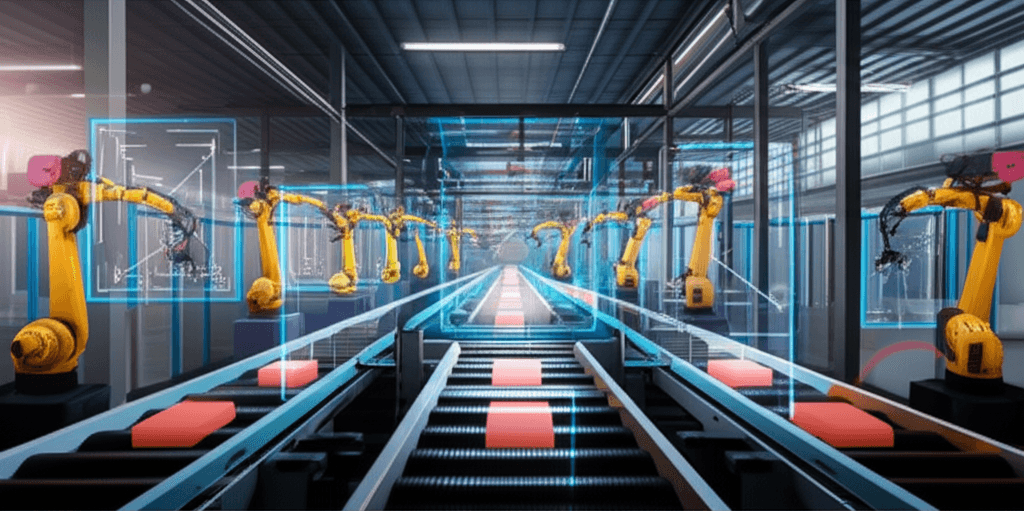
Computer Vision in Manufacturing: Automating Quality Control
Manual visual inspection has been the backbone of manufacturing quality assurance for decades. Human inspectors examine products on production lines, looking for scratches, dents, misalignments, and other defects. But this approach has fundamental limitations: humans fatigue after 20-30 minutes of sustained visual attention, miss subtle defects at rates of 20-30%, and cannot scale to the throughput demands of modern high-speed production lines. Computer vision powered by deep learning is changing this equation entirely, enabling manufacturers to inspect every single unit at speeds exceeding 1,000 parts per minute with consistent accuracy above 99%.
Camera Systems and Image Acquisition
The foundation of any computer vision inspection system is the imaging hardware. Modern manufacturing inspection typically uses area-scan cameras for discrete items or line-scan cameras for continuous web processes like textiles and sheet metal. Multispectral and hyperspectral cameras can detect defects invisible to the human eye by imaging beyond the visible spectrum — identifying subsurface cracks in ceramics, contamination in food products, or coating thickness variations in painted surfaces. Lighting design is equally critical: structured light, backlighting, and diffuse illumination each reveal different defect types. A well-engineered imaging station with appropriate optics and illumination can reduce the complexity required from the downstream AI model by an order of magnitude.
Training Models with Limited Defect Data
One of the biggest practical challenges in manufacturing computer vision is the scarcity of defect samples. A well-run production line produces very few defective units, which means training a supervised classifier on defect types can require months of data collection. Several strategies address this data imbalance. Anomaly detection approaches train only on "good" samples and flag anything that deviates from learned normalcy — autoencoders and self-supervised methods like PatchCore have proven especially effective here. Synthetic data generation using GANs or physics-based rendering can augment real defect datasets by 10-100x. Transfer learning from pretrained vision models like ResNet or EfficientNet dramatically reduces the number of labeled samples needed, often achieving production-ready accuracy with as few as 50-100 real defect images per class.
Edge Deployment and Real-Time Inference
Manufacturing inspection demands low-latency inference — typically under 50 milliseconds per frame to keep pace with production line speeds. Cloud-based inference introduces unacceptable network latency and creates a dependency on internet connectivity that factory environments cannot tolerate. Edge deployment on devices like NVIDIA Jetson, Intel Movidius, or industrial PCs with GPU acceleration is the standard approach. Model optimization through quantization (FP32 to INT8), pruning, and architecture-specific compilation with TensorRT or OpenVINO can reduce model size by 4-8x and increase inference speed by 3-5x with minimal accuracy loss. The most robust production systems run inference on dual redundant edge devices with automatic failover, ensuring that a hardware failure never stops the production line.
ROI and Business Impact
Manufacturers deploying computer vision inspection systems typically see measurable returns across several dimensions:
- Defect escape rate reduction of 80-95%, catching defects before they reach customers and avoiding costly recalls or warranty claims.
- Scrap and rework reduction of 30-60% by identifying defects earlier in the process, when corrective action is still possible and less material has been invested.
- Labor cost savings of 40-70% on inspection tasks, freeing skilled workers for higher-value activities like process optimization and root cause analysis.
- Typical payback period of 6-18 months, with total cost of ownership significantly lower than maintaining equivalent human inspection teams over a 5-year horizon.
Want to discuss these topics in depth?
Our engineering team is available for architecture reviews, technical assessments, and strategy sessions.
Schedule a consultation →